Brain Rot Analysis Lab

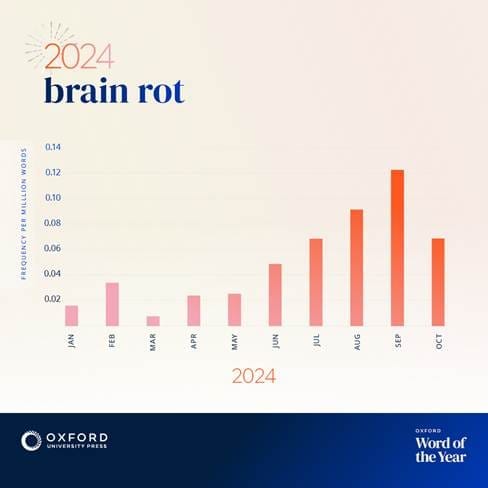
After a public vote of more than 37,000 votes and widespread conversation, Oxford University Press had declared ‘brain rot’ as the definitive Word of the Year 2024.
What Is Brain Rot?
According to OUP, it is the supposed deterioration of a person’s mental or intellectual state, especially viewed as the result of overconsumption of material (now particularly online content) considered to be trivial or unchallenging. Also: something characterized as likely to lead to such deterioration. While brain rot’s first-ever mention was in Henry David Thoreau’s Walden, 1854, it is between 2023 and 2024 that its usage frequency increased by 230%.[1]
Source: Oxford Word of the Year 2024, Oxford University Press
Browsing social media triggers a surge in dopamine, which is the brain’s reward chemical, creating sensations of pleasure and reward. This reinforces the habit, making us crave more and more. Our mind links the act of scrolling to instant gratification, fueling an addictive cycle. This endless scrolling is akin to slot machine games in casinos, with the payouts being those rare perfect Reels that may hit after variable swipes – each pull thrilling with uncertainty, fueling addiction despite frustration.
Netizens are aware, and receive constant reminders in more ways than one, that brain rot or doomscrolling is bad. The smartphone itself shows how many hours a person spends on, say, Instagram – the numbers are scary, the tone is alarming. That notification implies that there is something to worry about.
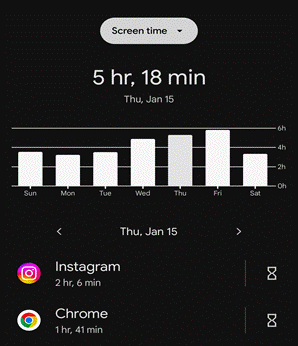
But is that always the case? Our personal experience says that not all the minutes spent on Instagram Reels are a complete waste. Some are spent scouting for informative content and specific reviews, some on keeping up with the popular culture, and others on guilty pleasure content. Our hunch going into this project was that the problem is not the amount of time spent on Instagram but the lack of individual control on what kind of content is consumed on the app.
According to media researcher Emilie Owens, ‘As a term, brain rot is most definitely not meant to be taken literally. Though the medical websites proposing brain rot as an emergent mental health crisis facing our society may be well meaning, their definition is misguided … As a genre of participation, brain rot is an oasis of calm amid the media chaos.’[2] It is a digital engagement style that lets users indulge in brainless content, giving their minds a temporary break.
Brain Rot Analysis Lab
This is Tattle Civic Technologies’ Brain Rot Analysis Lab, where we explore if we can use our expertise in automated web scraping and social media analysis to download and analyze the consumption pattern of Instagram Reels. This analysis sits at the intersection of algorithm auditing, user agency, and platform research, revealing how personalized feeds like the ones pioneered by TikTok and now implemented across Instagram Reels and YouTube Shorts shape our digital diets. Our first case study focuses on User 001, a real-world example of these dynamics in action.
How Was This Analysis Done?
User 001’s Instagram Reels data feed was downloaded and analyzed using Feluda, Tattle’s engine for analyzing a large amount of multimodal and multilingual data. It can analyze a large number of media items and find trends in them, which can greatly optimize workflows for fact-checking, content moderation, and even hate speech detection. In 2023, the Digital Public Goods Alliance (DPGA) and the United Nations Development Programme (UNDP) had launched a global call with the goal of discovering and highlighting innovative open-source solutions that can help promote information integrity. Feluda was one of the selected solutions.[3]
Methodology
A python script used geckodriver to automate browser actions. The script logged in as User 001 into their Instagram account, using their username and password and visited their Reels feed. Every few seconds, it swiped down to scroll through their account and collect the URLs of the reels.
The collected URLs were used to download the video file associated with the reel from Instagram’s server using an unofficial Instagram scraper called Instaloader. These media items were then processed using Feluda to do content-level analysis.
Technical Details
This experiment is designed as a nimble experiment without needing large compute power. The scraper and machine learning model used in the project can be run on a regular CPU. User 001’s 1472 video files take up around 7,7 Gb on disk. After compression (with some pixelation), they come down to around 932 MB.
The project is a mix of python script that a user can run independently on their machines to analyze their Instagram browsing history, and a few web apps that they can open in their browser locally to explore this data further.
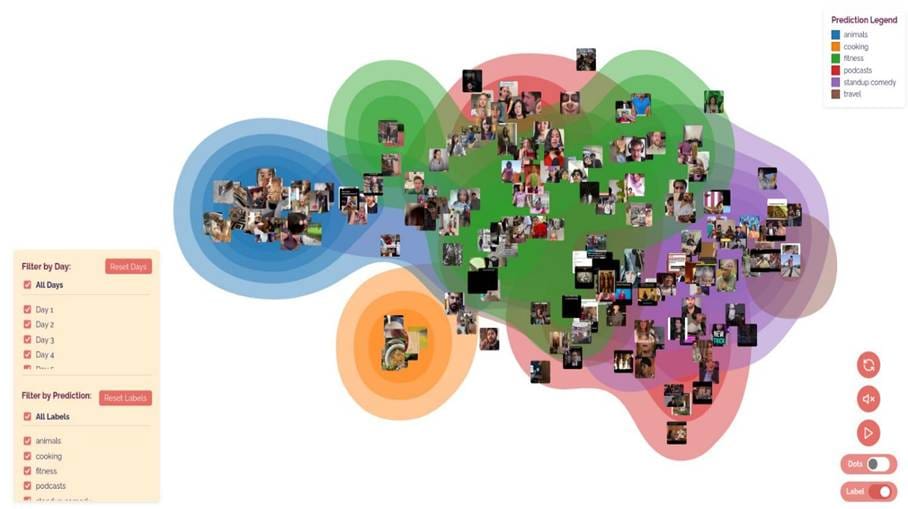
Source: Crowdsourced data of Instagram Reels by Tattle Civic Technologies
User 001 Analysis
We analyzed User 001’s consumption of 1,472 Instagram Reels over the course of five days between 23rd December 2025 to 27th December 2025. We learnt that his feed can be categorized into six categories: animals; cooking; fitness; podcasts; stand-up comedy; and travel. The biggest chunk belongs to stand-up comedy; and the smallest to fitness.
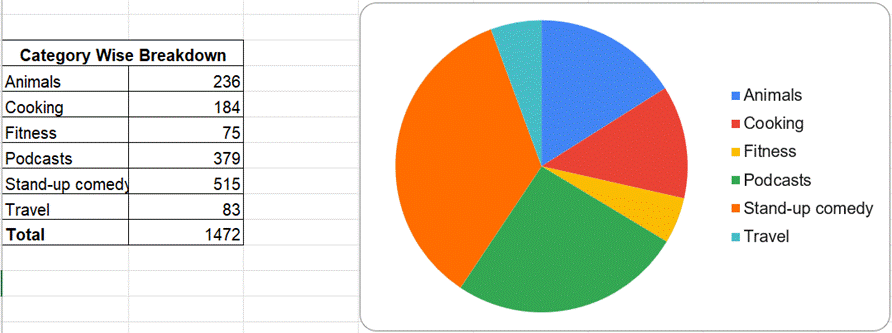
Source: Crowdsourced data of Instagram Reels by Tattle Civic Technologies
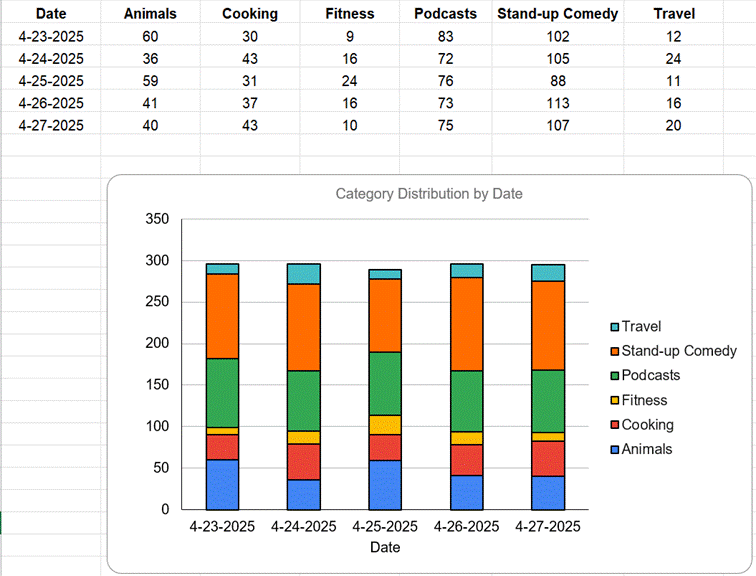
Source: Crowdsourced data of Instagram Reels by Tattle Civic Technologies
We also examined every watched Reel’s duration, which revealed the below stats. Assuming a normal distribution of video durations, these numbers reveal that 68% of videos recommended to User 001 were 5 seconds to 65 seconds long, which is shorter than what he had expected.
An in-person chat with User 001 revealed that during his brain rot breaks what he was really interested in were popular culture commentary Reels. Upon first-level analysis of his data, we don’t find that category at all. Our initial automated analysis found zero in that category. Manual review, however, revealed they were present – but miscategorized under Podcasts, making up nearly half of that group (which ranked second in consumption).
From the data and discussion, we infer that User 001’s preferred content appeared only about half the time within his second-favorite category. It’s a classic slot-machine effect: he doomscrolled countless 10-second clips, each swipe a gamble for that rare, rewarding hit.
User Agency
Imagine wresting control from Instagram’s elusive algorithm. At Tattle, we’re asking what if the users had more algorithmic control over their feed on the second most-used social network worldwide?[4] It isn’t impossible, given how another social media platform, Bluesky, an open source, decentralized social media platform, puts its users in control of what they see with its user-curated feeds. Needless to say, when users can adjust their feeds based on their preferences, it leads to a more personalized and engaging experience. From the social network’s point of view too, targeted engagement would prove to be more efficient than variable discovery. If users want to watch more cat Reels, let them choose that.
Open Call
At Tattle, we like to understand and research social media trends and user behaviours by using our tools and datasets. As part of our mission to foster a healthier online information ecosystem in India, we conduct regular research to study how social media platforms shape public discourse and individual experiences. For a glimpse into our research work, you can explore our earlier projects like Crowdsourcing Aid, where we analyzed WhatsApp groups to map community-driven COVID-19 responses, and Incentives to Share True Content Online, which experimented with gamified rewards to promote factual sharing.
We’re excited to invite you to collaborate with us now on the Brain Rot Analysis Lab. Donate your anonymized Instagram data and join us for a personalized analysis call. We’ll categorize your Reels consumption, reveal hidden patterns in your Instagram behaviour, and discuss insights into your digital habits. This partnership will help advance our collective understanding of algorithmic influence.
Get support
If you feel your brain rot has escalated into a serious issue, seek help right away. Avoid retreating into screens, where digital addiction can fully take hold. Connect with a therapist or mental health expert to confront the problem, build better habits, handle triggers, and establish achievable goals.
[1] ‘Brain rot’ named Oxford Word of the Year 2024, Oxford University Press, 2 Dec 2024, https://corp.oup.com/
[2] Emilie Owens, ‘Why teenagers are deliberately seeking brain rot on TikTok’, Psyche, 8 October 2024.
[3] Feluda, Open-source Innovations for Information Integrity, 24 May 2023, https://www.youtube.com/watch?v=ohCjIngQedI&t=8s
[4] ‘Most popular social networks worldwide as of February 2025, by number of monthly active users’, Statista, https://www.statista.com/statistics/272014/global-social-networks-ranked-by-number-of-users/?srsltid=AfmBOooNgzHyh0IReG3C_mIQoLOfyPq4zYix7ZAwXi2WvbE3MDhBaEiO